
[𝘖𝘶𝘳 𝘭𝘪𝘵𝘵𝘭𝘦 𝘴𝘵𝘶𝘥𝘺 𝘨𝘳𝘰𝘶𝘱, 𝘸𝘰𝘳𝘬𝘪𝘯𝘨 𝘵𝘩𝘳𝘰𝘶𝘨𝘩 𝘕𝘢𝘯𝘤𝘺 𝘓𝘦𝘪𝘨𝘩 𝘋𝘦𝘔𝘰𝘴𝘴 𝘞𝘰𝘭𝘨𝘦𝘮𝘶𝘵𝘩’𝘴 𝘣𝘰𝘰𝘬 𝘢𝘯𝘥 𝘢𝘤𝘤𝘰𝘮𝘱𝘢𝘯𝘺𝘪𝘯𝘨 𝘴𝘵𝘶𝘥𝘺 𝘨𝘶𝘪𝘥𝘦, “𝘚𝘜𝘙𝘙𝘌𝘕𝘋𝘌𝘙: 𝘵𝘩𝘦 𝘏𝘦𝘢𝘳𝘵 𝘎𝘖𝘋 𝘊𝘰𝘯𝘵𝘳𝘰𝘭𝘴”, 𝘪𝘴 𝘯𝘰𝘸 𝘰𝘯 𝘴𝘶𝘮𝘮𝘦𝘳 𝘣𝘳𝘦𝘢𝘬. 𝘐 𝘩𝘢𝘷𝘦 𝘣𝘦𝘦𝘯 𝘨𝘳𝘢𝘵𝘦𝘧𝘶𝘭 𝘧𝘰𝘳 𝘵𝘩𝘪𝘴 𝘵𝘪𝘮𝘦 𝘵𝘰 𝘳𝘦𝘳𝘦𝘢𝘥 𝘢𝘯 𝘰𝘭𝘥𝘪𝘦 𝘣𝘶𝘵 𝘨𝘰𝘰𝘥𝘪𝘦 𝘣𝘰𝘰𝘬 𝘵𝘩𝘢𝘵 𝘳𝘦𝘪𝘯𝘧𝘰𝘳𝘤𝘦𝘴 𝘢𝘯𝘥 𝘤𝘰𝘮𝘱𝘭𝘪𝘮𝘦𝘯𝘵𝘴 𝘭𝘦𝘴𝘴𝘰𝘯𝘴 𝘸𝘦 𝘩𝘢𝘷𝘦 𝘣𝘦𝘦𝘯 𝘭𝘦𝘢𝘳𝘯𝘪𝘯𝘨 𝘪𝘯 𝘰𝘶𝘳 𝘴𝘵𝘶𝘥𝘺. 𝘐𝘵 𝘪𝘴 𝘮𝘺 𝘱𝘳𝘢𝘺𝘦𝘳 𝘵𝘩𝘢𝘵 𝘴𝘩𝘢𝘳𝘪𝘯𝘨 𝘴𝘰𝘮𝘦 𝘰𝘧 𝘵𝘩𝘦 𝘴𝘦𝘤𝘵𝘪𝘰𝘯𝘴 𝘐 𝘩𝘪𝘨𝘩𝘭𝘪𝘨𝘩𝘵𝘦𝘥 𝘪𝘯 𝘮𝘺 𝘰𝘸𝘯 𝘳𝘦𝘢𝘥𝘪𝘯𝘨 𝘸𝘪𝘭𝘭 𝘣𝘦 𝘢𝘯 𝘦𝘯𝘤𝘰𝘶𝘳𝘢𝘨𝘦𝘮𝘦𝘯𝘵 𝘵𝘰 𝘴𝘰𝘮𝘦𝘰𝘯𝘦 𝘦𝘭𝘴𝘦.]
Elizabeth Elliot states it with such clarity: discipline is simply the life of a disciple. As followers (and students) of CHRIST, our choices, our mindset, our very lifestyle is not one determined by our own preferences – we are directed by the One whom we follow.
She suggests that when we fully appreciate the One to whom we have pledged our allegiance, discipline is not resigned drudgery, but joyful surrender to the One who is worthy of our trust and our unquestioning obedience.
Elizabeth Elliot sets the stage with a touching thought: we are “created, cared for, and called” by a loving Father. She then beautifully connects our relationship with GOD our Father to her own experience of growing up in a loving home (p. 15):
“As a child in a Christian home, I did not start out with an understanding of the word ‘discipline’. I simply knew that I belonged to people who loved me and cared for me. That is dependence. They spoke to me, and I answered. That is responsibility. They gave me things to do, and I did them. That is obedience. It adds up to discipline. In other words, the totality of the believer’s response is discipline. It defines the very shape of the disciple’s life. Discipline is the believer’s response to GOD’s call.”
Our Savior is always our ultimate example (p. 16):
“JESUS, in response to the will of the Father, demonstrated what it means to be fully human when He took upon Himself the form of a man and in so doing voluntarily and gladly chose both dependence and obedience. Humanity for us, as for CHRIST, means both dependence and obedience.”
Elizabeth Elliot concludes her opening comments this way (p. 16):
“Discipline is the wholehearted yes to the call of GOD. When I know myself called, summoned, addressed, taken possession of, known, acted upon, I have heard the Master. I put myself gladly, fully, and forever at His disposal, and to whatever He says my answer is yes.”
In a later chapter, Elizabeth Elliot makes an important distinction (p. 37-38):
“Willing obedience is a very different thing from coercion. A college dean once observed that the happiest students on any campus are the musicians and the athletes. ‘Why?’ I asked. ‘Because they’re disciplined, and they volunteered to be disciplined.’ People sitting in required lectures are under discipline … but athletes and musicians put themselves under a coach or director who tells them what to do. They delight to do his will. They are actually having fun.
GOD does not coerce us to follow Him. He invites us. He wills that we should will – that is, He wills our freedom to decline or to accept. If we want to be disciples, we place ourselves, like the football player and the instrumentalist, under someone’s direction. He tells us what to do, and we find our happiness in doing it. We will not find it anywhere else. We will not find it by doing only what we want to do and not doing what we don’t want to do. That is the popular idea of what freedom is, but it does not work.
Freedom lies in keeping the rules. Joy is there too. (If only we would keep the joy in view!) The violinist in the orchestra submits first to the instructor. He obeys the rules laid down by him and handles his instrument accordingly. He submits then to the music as written by the composer, paying attention to the markings for dynamics as well as to notes, rests, and timing. Finally, he submits to the conductor. The conductor tells him, by word or gesture what he wants, and the violinist does just that.
Is there any image of freedom and joy more exhilarating than a full orchestra, everybody sawing, tootling, pounding, strumming, blowing, clashing, and hammering away for all they are worth, under the direction of the immense energy and discipline of a man who knows every note of every instrument in every concerto and knows how to elicit that note exactly so that it will contribute most fully to the glory of the work as a whole?”
. . .
In the remaining chapters of her book, Elizabeth Elliot details practical applications of ‘discipline’ in various areas of our lives: body, mind, place, time, possessions, work, and feelings. My attention was particularly drawn to her comments about managing our time, a GOD-honoring view of our possessions, and a Spirit-led perspective about our emotions.
from “The Discipline of Time” (p. 94, 99-100):
“Not even the tiny dewdrop lacks the care and attention of the Lover of all. Shall I then think of any detail of my earthly life, even so little a thing as a minute of one of my hours, as without meaning? How shall I answer to my Master for my time?
I was brought up to believe that it is a sin to be late. To cause others to wait for you, my parents taught us, is to steal from them one of their most precious commodities. Time is a creature – a created thing – and a gift. We cannot make any more of it. We can only receive it and be faithful stewards in the use of it.
‘I don’t have time’ is probably a lie more often than not covering ‘I don’t want to.’ We have time – twenty-four hours in a day, seven days in a week. … Demands on our time differ, of course, and it is here that the disciple must refer to his Master. What do You want me to do, LORD? There will be time, depend upon it, for everything GOD wants us to do. …
There were endless demands on JESUS’ time. People pressed on Him with their needs so that He and His disciples had not leisure even to eat, and He would go away into the hills to pray and be alone. … How many ‘if onlys’ He must have left behind, how much more that He ‘could have’ done. There must have been things, also, that JESUS Himself would have liked to do during those three packed years of His public ministry, but He was a man, with a man’s limitations of time and space. Still, He was able to make that amazing claim, ‘I have finished the work You gave Me to do’ (John 17:4).
This was not the same as saying He had finished everything He could possibly think of to do or that He had done everything others had asked. He made no claim to have done what He wanted to do. The claim was that He had done what had been given.
This is an important clue for us. The work of GOD is appointed. What was given to the Son to do was the will of the Father. What is given to us to do is also His will. There is always enough time to do the will of GOD.”
from “The Discipline of Possessions” (p. 108):
“Because GOD gives us things indirectly, by enabling us to make them with our own hands (out of things He has made, of course), or to earn the money to buy them, or to receive them through someone else’s giving, we are prone to forget that He gave them to us.
‘What do you possess that was not given to you? If then you really received it all as a gift, why take the credit to yourself?’ (1 Corinthians 4:7).
The taking of credit becomes an absurdity when we remember that not only the brains, abilities, and opportunities for achievement are gifts, but also the very air we breathe and the ability to draw it into our lungs.
We should be thankful. Thanksgiving requires the recognition of the Source. It implies contentment with what is given, not complaint about what is not given. It excludes covetousness. The goodness and love of GOD choose the gifts, and we say thank You, acknowledging the Thought Behind as well as the thing itself.
Covetousness involves suspicion about the goodness and love of GOD, and even His justice. He has not given me what He gave somebody else. He doesn’t notice my need. He doesn’t love me as much as He loves him. He isn’t fair.
Faith looks up with open hands. ‘You are giving me this, LORD? Thank You. It is good and acceptable and perfect.’”
from “The Discipline of Feelings” (p. 133, 141, 145):
“’I have a lot of trouble with this,’ said the student. ‘I mean, I’m just not sure how to work this out comfortably.’ ‘Work it out comfortably?’ queried the Bible teacher. ‘What has that got to do with the will of GOD?’
‘Feeling comfortable’ has become terribly important, but there is nothing new about reluctance. Feelings, like thoughts, must be brought into captivity. No one whose first concern is feeling good can be a disciple.
What sort of things will characterize the life of one who obeys the Spirit? ‘Love, joy, peace, patience, kindness, goodness, fidelity, gentleness, and self-control’ (Galatians 5:22-23).
Note that self-control is one of the fruits of the Spirit. Here is evidence again of man’s responsibility to cooperate with GOD in His work. It is not all ‘Spirit control.’ Self-control is essential. The man who has accepted the rule of the Spirit in his life will accept spiritual discipline. In accepting the discipline of his Master, he will willingly discipline himself. This is a sign of spiritual maturity, just as it is a sign of emotional maturity.
It is the will that must deal with the feelings. The will must triumph over them, but only the will that is surrendered to CHRIST can do this.
A few final words of caution:
Do not debunk feelings as such. Remember they are given to us as part of our humanity. Do not try to fortify yourself against emotions. Recognize them; name them, if that helps; and then lay them open before the LORD for His training of your responses. The discipline of emotions is the training of responses.
He who summons is He who empowers. He is Master. As we give ourselves to His rule He gives us grace to rule.
Saint Francis de Sales put it this way: ‘We are not masters of our own feelings but we are by GOD’s grace master of our consent.’
Try it. When, in the face of powerful temptation to do wrong, there is a swift hard renunciation – I will not – it will be followed by the sudden loosing of the bonds of self, the yes to GOD that lets in sunlight, sets us singing and all freedom’s bells clanging for joy.”
Elizabeth Elliot closes her thoughts with a return to the picture of a healthy parent-child relationship that contributes to a happy home (p. 147-150):
“ ‘Happy are they who obey His instruction, who set their hearts on finding Him’ (Psalm 119:2). When children surrender gladly to their parents’ instruction, it is sunny weather for all. When they refuse, storm clouds gather.
The goal of every true disciple is to please His GOD. The Bible is our guidebook, showing us how to do that. … Why then, instead of taking CHRIST at His Word, do we prefer to argue (‘it’s too hard, too restrictive, it isn’t my thing’), to claim our ‘rights’ to muddle through on our own? In this way paradise was lost. It is the same enemy who comes to us today with the same lie (‘you shall not die, but live’). Yet still faithfully JESUS calls to life and to utter bliss those who will follow His way.
He offers an exchange: His life for ours. He showed us what He meant by giving Himself. The overwhelming fact of the Son’s obedience to the Father – hell itself harrowed by the Infinite Majesty – does it not call us far out of ourselves, far beyond the pitiful, calculating, cowardly, self-serving, self-saving pursuit of what the world calls happiness?
He offers us love, acceptance, forgiveness, a weight of glory, fullness of joy. Is it so hard to offer back the gifts that came in the first place from the wounded hands – body, mind, place, time, possessions, work, feelings?
When discipline becomes a glad surrender, ‘Every day we experience something of the death of JESUS, so that we may also know the power of JESUS in these bodies of ours’ (2 Corinthians 4:10).”
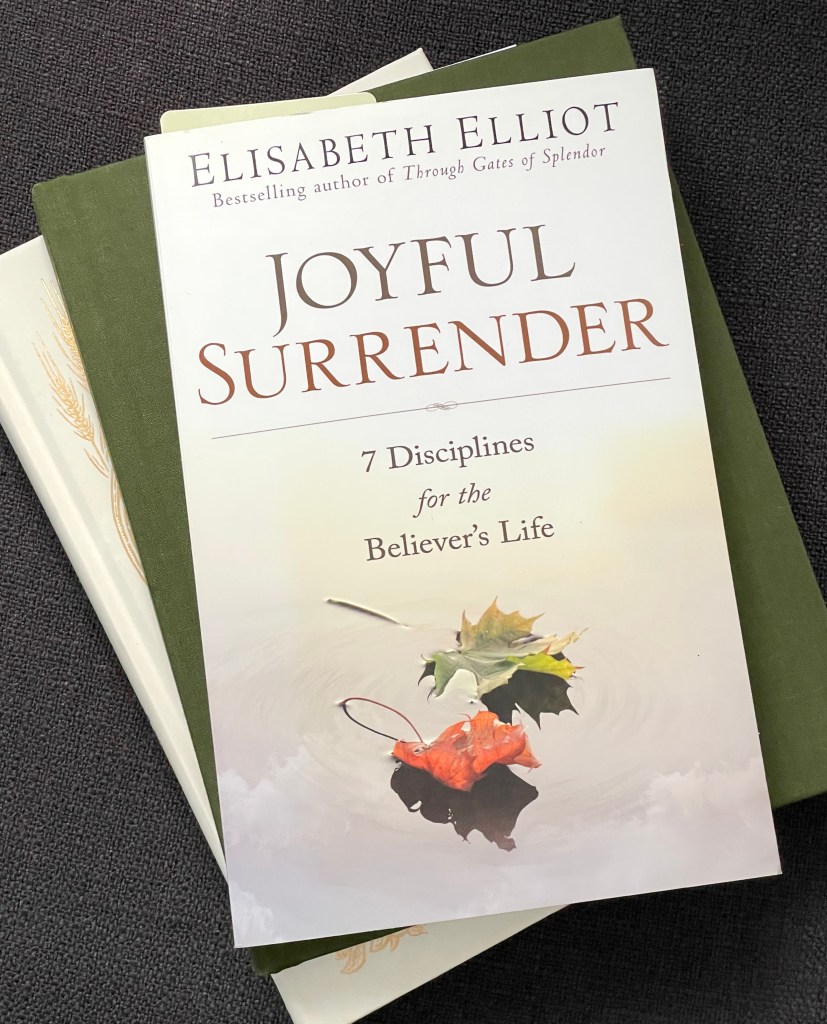
Glad surrender. The heart GOD controls. Not mine, but His. All of it. There is no better place to be than fully in step with the Father’s plan. These are the lessons we have been learning about surrender that have been so beautifully echoed in the pages of Elizabeth Elliot’s book, “Joyful Surrender.” I am grateful it was suggested as our summer reading in the midst of our surrender study!
𝘊𝘳𝘦𝘢𝘵𝘦𝘥 𝘣𝘺 𝘎𝘖𝘋, 𝘧𝘰𝘳 𝘏𝘪𝘴 𝘨𝘰𝘰𝘥 𝘱𝘭𝘦𝘢𝘴𝘶𝘳𝘦, 𝘧𝘰𝘳 𝘏𝘪𝘴 𝘨𝘭𝘰𝘳𝘺.
𝘊𝘢𝘳𝘦𝘥 𝘧𝘰𝘳 𝘢𝘣𝘶𝘯𝘥𝘢𝘯𝘵𝘭𝘺 𝘣𝘺 𝘰𝘶𝘳 𝘩𝘦𝘢𝘷𝘦𝘯𝘭𝘺 𝘍𝘢𝘵𝘩𝘦𝘳.
𝘊𝘢𝘭𝘭𝘦𝘥 𝘵𝘰 𝘮𝘢𝘬𝘦 𝘵𝘩𝘦 𝘧𝘳𝘦𝘦 𝘤𝘩𝘰𝘪𝘤𝘦 𝘵𝘰 𝘧𝘰𝘭𝘭𝘰𝘸 𝘰𝘶𝘳 𝘚𝘢𝘷𝘪𝘰𝘳.
𝘋𝘦𝘱𝘦𝘯𝘥𝘦𝘯𝘵. 𝘙𝘦𝘴𝘱𝘰𝘯𝘴𝘪𝘣𝘭𝘦. 𝘖𝘣𝘦𝘥𝘪𝘦𝘯𝘵.
𝘞𝘪𝘭𝘭𝘪𝘯𝘨𝘭𝘺 𝘥𝘪𝘴𝘤𝘪𝘱𝘭𝘪𝘯𝘦𝘥 𝘣𝘦𝘤𝘢𝘶𝘴𝘦 𝘸𝘦 𝘢𝘳𝘦 𝘩𝘦𝘭𝘥 𝘢𝘯𝘥 𝘣𝘦𝘭𝘰𝘷𝘦𝘥 𝘢𝘯𝘥 𝘭𝘦𝘥 𝘣𝘺 𝘏𝘪𝘴 𝘚𝘱𝘪𝘳𝘪𝘵 𝘵𝘰 𝘱𝘭𝘦𝘢𝘴𝘦 𝘵𝘩𝘦 𝘍𝘢𝘵𝘩𝘦𝘳.
𝘛𝘩𝘪𝘴 𝘪𝘴 𝘵𝘳𝘶𝘦 𝘴𝘦𝘤𝘶𝘳𝘪𝘵𝘺 𝘢𝘯𝘥 𝘵𝘩𝘦 𝘴𝘰𝘶𝘳𝘤𝘦 𝘰𝘧 𝘥𝘦𝘦𝘱, 𝘪𝘯𝘥𝘸𝘦𝘭𝘭𝘪𝘯𝘨 𝘫𝘰𝘺!
LORD, help us to lay down any fight left in us that insists on stubborn independence and self-sufficiency and simply fall into Your embrace of grace and growth and priceless glimpses of Your glory! For You, alone, are worthy of our trust, our allegiance, and our love – because You first loved us.
 the cover of His Presence